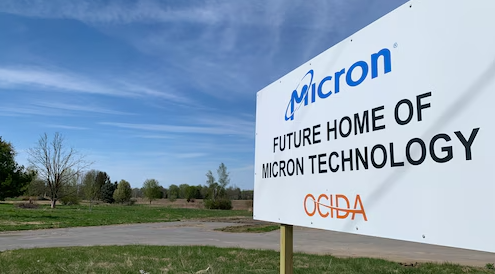


Following the US's push into production, Europe appears to be next, as the French president is now eager to bring TSMC and Samsung into the country to acquire high-end nodes domestically.
Europe's chip boom
As global supply chains have evolved dramatically, countries have shifted their focus to meeting chip demand through local production. The rush began with President Trump's inauguration, who treated chip production as a matter of national security and introduced massive investments, especially from TSMC. Now, countries seem to be following the US lead, for example, at the VivaTech conference, French President Emmanuel Macron expressed his desire to develop a domestic supply of cutting-edge semiconductors, saying it has become a necessity.
During a panel discussion, Macron specifically emphasized the importance of semiconductors to countries around the world. He revealed that he is interested in developing facilities capable of producing nodes from 2nm to 10nm. However, given France's existing resources, it may require external entities to set up facilities in the region. Macron said he would need to convince TSMC or Samsung to set up facilities in France. This shows that Europe is ready to shift to self-reliance in the chip sector; however, whether this move is feasible remains to be seen.
Production challenges
Europe had high hopes for access to cutting-edge chips when TSMC announced a large, government-funded project in Germany. However, people do not seem optimistic that TSMC's German factory will be operational soon. In addition, countries like France, which are not involved in developing products that require high-end semiconductors, are likely to have mastered mature process nodes such as 16nm, especially in the automotive industry. Therefore, the prospects of TSMC/Samsung setting up a fab in France are slim.
However, given that production is shifting from the East to the West, Europe needs to find a stable source of chips because if they source from the United States, they will most likely need to pay an additional "US premium" in the form of tariffs. Similarly, if the region does not have its own supply, countries like China may be forced to supply chips in the region, increasing their influence over local domestic production.
Nvidia's first GPU, manufactured by ST
French President Emmanuel Macron said on Wednesday that France will produce the world's most advanced chips in an effort to position itself as a key tech hub in Europe.
At a time when European tech companies and countries are reassessing their reliance on foreign tech companies for key technologies and infrastructure.
Chip manufacturing in particular became a hot topic as Nvidia CEO Jensen Huang participated in a panel discussion on Wednesday with Macron and Mistral AI CEO Arthur Mensch. Huang said the company's first graphics processing unit (GPU) was produced by France's SGS Thomson Microelectronics, now known as STMicroelectronics.
However, STMicroelectronics is not currently a leader in semiconductor manufacturing. Most of the chips it produces are for industries such as automobiles that do not require the most cutting-edge semiconductors.
Nevertheless, Macron has ambitiously stated that France will be able to manufacture semiconductors in the 2-nanometer to 10-nanometer range.
"If we want to consolidate our industry, we now have to produce more and more chips at the right scale," Macron said on Wednesday.
The smaller the number of nanometers, the more transistors can fit in a chip, resulting in more powerful semiconductors. Apple's latest iPhone chip, for example, is based on 3-nanometer technology.
Few companies can produce chips of this level at scale, with Samsung and Nvidia supplier Taiwan Semiconductor Manufacturing Co. (TSMC) leading the way.
If France wants to produce these cutting-edge chips, it may need TSMC or Samsung to build factories locally — something that's already happening in the U.S., where TSMC has pledged billions of dollars to build more factories.
Macron touted a deal between Thales, Radiall and Taiwan’'s Foxconn to explore building semiconductor assembly and testing plants in France.
"I want to convince them to manufacture in France," Macron said at VivaTech, one of France's largest tech events. That same day, Nvidia's Huang Jen-Hsun announced a series of deals to build more AI infrastructure in Europe.
One of the key collaborations Huang announced was between Nvidia and French AI modeler Mistral to build what it calls an "AI cloud."
France has been working to build its AI infrastructure. Macron said in February that France’s AI sector would receive €109 billion ($125.6 billion) in private investment over the next few years. Macron praised Nvidia's cooperation with Mistral as an extension of France's artificial intelligence construction.
Macron told CNBC on Wednesday: "We are increasing (investment) and accelerating. The measures announced this morning by Mistral AI and Nvidia will also change the rules of the game."
Content compiled from wccftech