

Today, Google announced research demonstrating that—for the first time—a quantum computer can successfully run a verifiable algorithm in hardware, outperforming even the fastest classical supercomputers (up to 13,000 times faster). This can calculate molecular structures and paves the way for practical applications. Today's progress builds on decades of research and six years of major breakthroughs.
Back in 2019, Google demonstrated that quantum computers could solve problems that would take even the fastest classical supercomputers thousands of years. Then, late last year (2024), Google's new Willow quantum chip demonstrated how to significantly suppress errors, solving a major problem that has plagued scientists for nearly 30 years. Today's specification breakthrough brings us closer to quantum computers capable of driving significant discoveries in fields such as medicine and materials science.
Imagine searching for a lost ship on the ocean floor. Sonar technology might give you a vague outline and tell you, "There's a shipwreck." But what if you could not only find the ship but also read the nameplate on its hull?
This is the unprecedented precision Google has just achieved with its Willow quantum chip. Today, Google is announcing a major algorithmic breakthrough, marking a significant step toward its first practical application. Our paper, just published in Nature, demonstrates the first verifiable quantum advantage in running the out-of-order time correlator (OTOC) algorithm, which Google calls "Quantum Echoes."
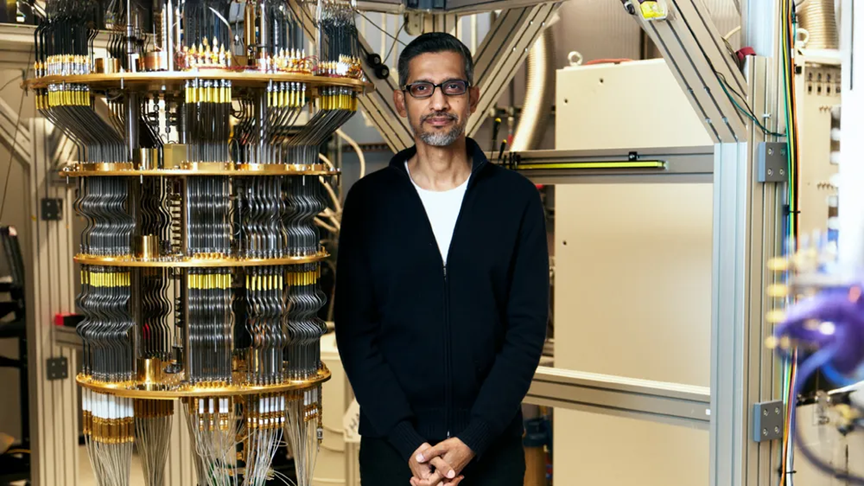
Quantum Echoes Algorithm
Verifiable Quantum Advantage
This marks the first time in history that a quantum computer has successfully run a verifiable algorithm that exceeds the capabilities of supercomputers. Quantum verifiability means that the results can be replicated on Google's quantum computer (or any other quantum computer of comparable caliber) with the same answer, thus confirming the outcome. This repeatable, superclassical computation is the foundation for scalable verification, bringing quantum computers closer to practical applications.
Google's new technology acts like a highly advanced echo. We send a carefully designed signal into our quantum system (the qubits on the Willow chip), perturb one qubit, and then precisely reverse the signal's evolution to listen for the returning "echo."
This quantum echo is special because it is amplified by constructive interference (a phenomenon where quantum waves are superimposed). This makes Google's measurements extremely sensitive.
The Quantum Echoes algorithm is made possible by advances in the quantum hardware of Google's Willow chip. Last year, Willow demonstrated its strong performance on our random circuit sampling benchmark, which aims to measure the maximum complexity of quantum states. The Quantum Echoes algorithm represents a completely new class of challenges because it simulates physical experiments. This means the algorithm tests not only complexity but also the accuracy of the resulting calculation. This is why we call it "quantum-verifiable," meaning its results can be cross-benchmarked and verified using another quantum computer of similar quality. To achieve this balance of accuracy and complexity, the hardware must possess two key characteristics: extremely low error rates and high computational speed.
Quantum computers will play a vital role in modeling quantum mechanical phenomena, such as the interactions of atoms and particles and the structure (or shape) of molecules. One of the tools scientists use to understand chemical structure is nuclear magnetic resonance (NMR), which shares the same scientific principles behind magnetic resonance imaging (MRI). NMR acts like a molecular microscope, powerful enough to visualize the relative positions of atoms, helping us understand molecular structure. Modeling molecular shape and dynamics is fundamental to chemistry, biology, and materials science, and advances in this area will underpin advances in fields ranging from biotechnology to solar energy to nuclear fusion.
In a proof-of-principle experiment conducted in collaboration with the University of California, Berkeley, we validated our approach by running a quantum echo algorithm on a Willow chip, studying two molecules (one containing 15 atoms and the other 28 atoms). The results from our quantum computer were consistent with those from conventional NMR and revealed information not normally available from NMR, providing crucial validation of our approach.
Just as telescopes and microscopes have opened up new, unseen worlds, this experiment is a step toward a "quantum telescope" capable of measuring previously unobservable natural phenomena. Quantum computing-enhanced nuclear magnetic resonance (NMR) has the potential to become a powerful tool in drug discovery, helping to determine how potential drugs bind to their targets. Or, in materials science, it could be used to characterize the molecular structure of novel materials such as polymers, battery components, and even the materials that make up our quantum bits (qubits).
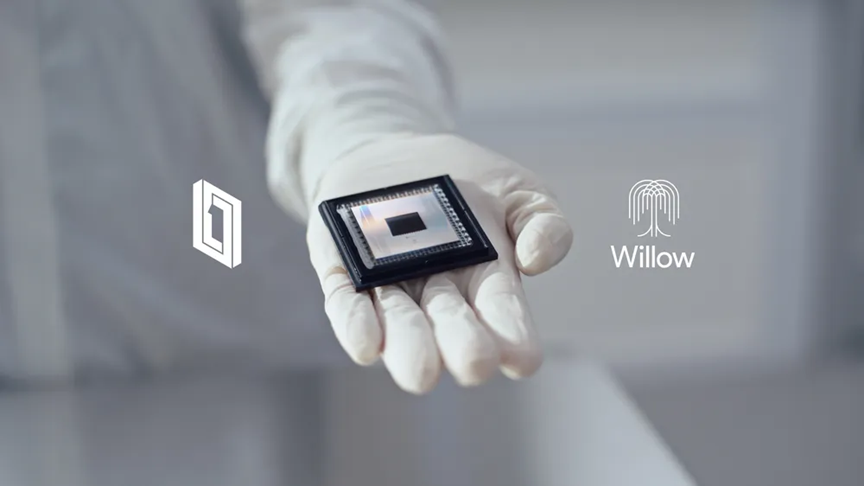
Willow, Google's most advanced quantum chip
Last June, Google unveiled its latest quantum chip, Willow. Willow boasts state-of-the-art performance across multiple metrics and achieved two significant feats:
First, Willow exponentially reduces errors as the number of qubits increases. This solves a key challenge in quantum error correction that has been pursued for nearly 30 years.
Second, Willow completed a standard benchmark calculation in five minutes, while one of today's fastest supercomputers would take 10⁷ (10₂₅) years—a number far exceeding the age of the universe.
Google stated that the Willow chip is a significant step forward in a journey that began more than a decade ago. In 2012, when the Google team founded Google Quantum AI, their vision was to build a practical, large-scale quantum computer that would leverage quantum mechanics—what we now know as nature's "operating system"—to advance scientific discovery, develop practical applications, and address some of society's greatest challenges, ultimately benefiting society. As part of Google Research, our team has developed a long-term roadmap, and Willow represents a significant step forward in this journey, moving us closer to commercial applications.
Errors are one of the biggest challenges facing quantum computing because qubits (the computational units of quantum computers) tend to rapidly exchange information with their environment, making it difficult to protect the information needed to complete a calculation. Typically, the more qubits used, the more errors occur, and the system eventually reverts to a classical state.
Published in Nature, Google has published results demonstrating that the more qubits used in Willow, the fewer errors there are, and the more quantum-like the system becomes. Google tested increasingly larger arrays of physical qubits, expanding from a 3x3 grid of coded qubits to a 5x5 grid, and then to a 7x7 grid—each time, leveraging Google's latest advances in quantum error correction, Google was able to halve the error rate. In other words, Google achieved an exponential reduction in the error rate. This historic achievement is known in the field as "below the threshold"—the ability to reduce errors while increasing the number of qubits. Demonstrating sub-threshold error correction is essential to demonstrate real progress in error correction, a significant challenge since Peter Shor proposed quantum error correction in 1995.
This achievement also involves other scientific firsts. For example, it is one of the first compelling examples of real-time error correction in a superconducting quantum system—critical for any useful computation, as errors can ruin the computation before it completes if they are not corrected quickly enough. Furthermore, this is a "beyond break-even" demonstration, with Google's qubit array lasting longer than a single physical qubit, an undeniable sign that error correction is improving the overall system.
As the first sub-threshold system, it is the most convincing prototype of a scalable logical qubit built to date. This strongly suggests that practical, ultra-large-scale quantum computers are indeed possible. Willow brings us closer to running practical and commercially valuable algorithms that are impossible to replicate on classical computers.
To measure Willow's performance, Google used the Random Circuit Sampling (RCS) benchmark. Pioneered by the Google team and now widely used as a standard in the field, RCS is the most challenging classical benchmark that can be achieved on quantum computers today. You can think of this as an entry point into quantum computing—it checks whether a quantum computer is performing operations that a classical computer can't. Any team building a quantum computer should first check whether it can beat a classical computer on RCS; otherwise, there's good reason to doubt its ability to handle more complex quantum tasks. We've been using this benchmark to evaluate progress from one chip generation to the next—Google reported Sycamore results in October 2019 and again more recently in October 2024.
Willow's performance on this benchmark is astonishing: it completed a calculation in less than five minutes that would take one of today's fastest supercomputers 10^25 or 10^7^8 years. Put into words, that's 10,000,000,000,000,000,000,000,000 years. This mind-boggling number transcends known timescales in physics and far exceeds the age of the universe. It confirms the idea that quantum computing occurs in multiple parallel universes, consistent with David Deutsch's prediction that we live in a multiverse.
As shown in the figure below, Willow's latest results are the best yet at the time of publication.
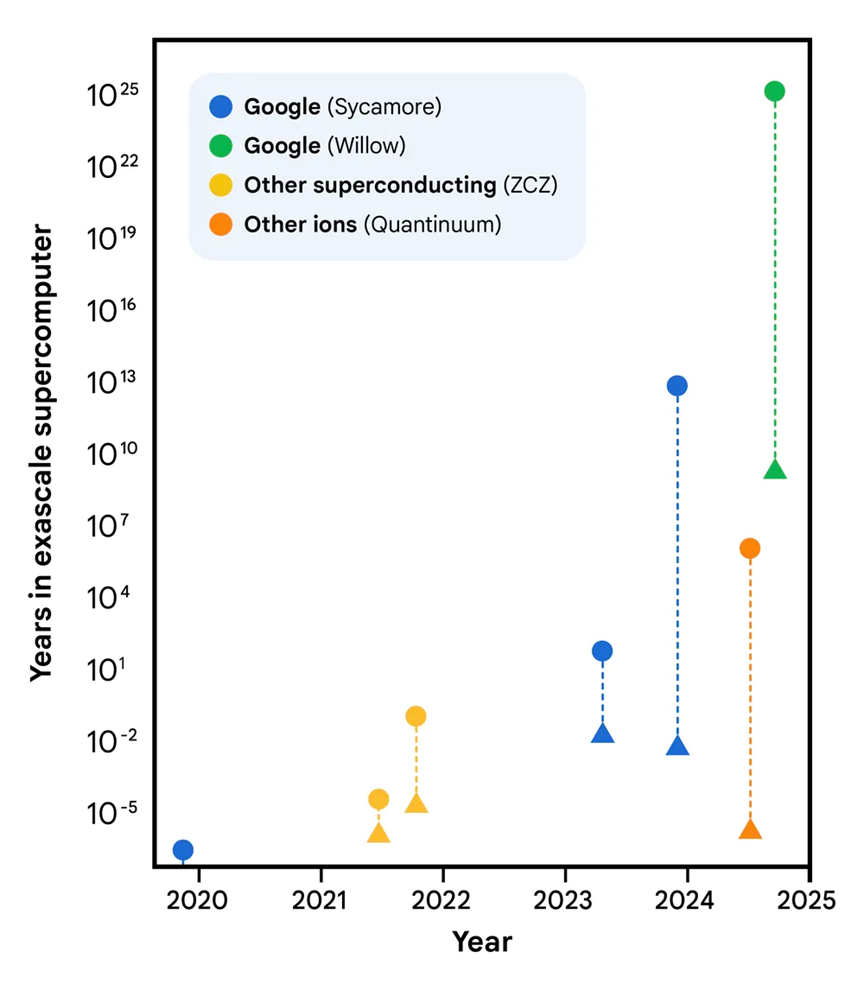
Google's assessment of how Willow will outperform Frontier, one of the world's most powerful classical supercomputers, is based on conservative assumptions. For example, Google assumes that Willow has full access to secondary storage (i.e., hard drives) without any bandwidth overhead—a generous and unrealistic assumption for Frontier. Of course, as with Google's announcement of its first superclassical computation in 2019, Google expects classical computers to continue improving on this benchmark, but the rapidly widening gap suggests that quantum processors are gaining ground on classical computers at a doubly exponential rate and will continue to significantly outperform them as they scale.
Willow is manufactured at Google's brand-new advanced manufacturing facility in Santa Barbara—one of only a few purpose-built facilities worldwide. Systems engineering is key to designing and manufacturing quantum chips: all components of the chip, such as single- and two-qubit gates, qubit reset, and readout, must be carefully designed and integrated simultaneously. If any component lags in performance, or if two components don't work well together, system performance will be hindered. Therefore, maximizing system performance permeates every aspect of our process, from chip architecture and manufacturing to gate development and calibration. The results we report evaluate the quantum computing system as a whole, not just one element at a time.
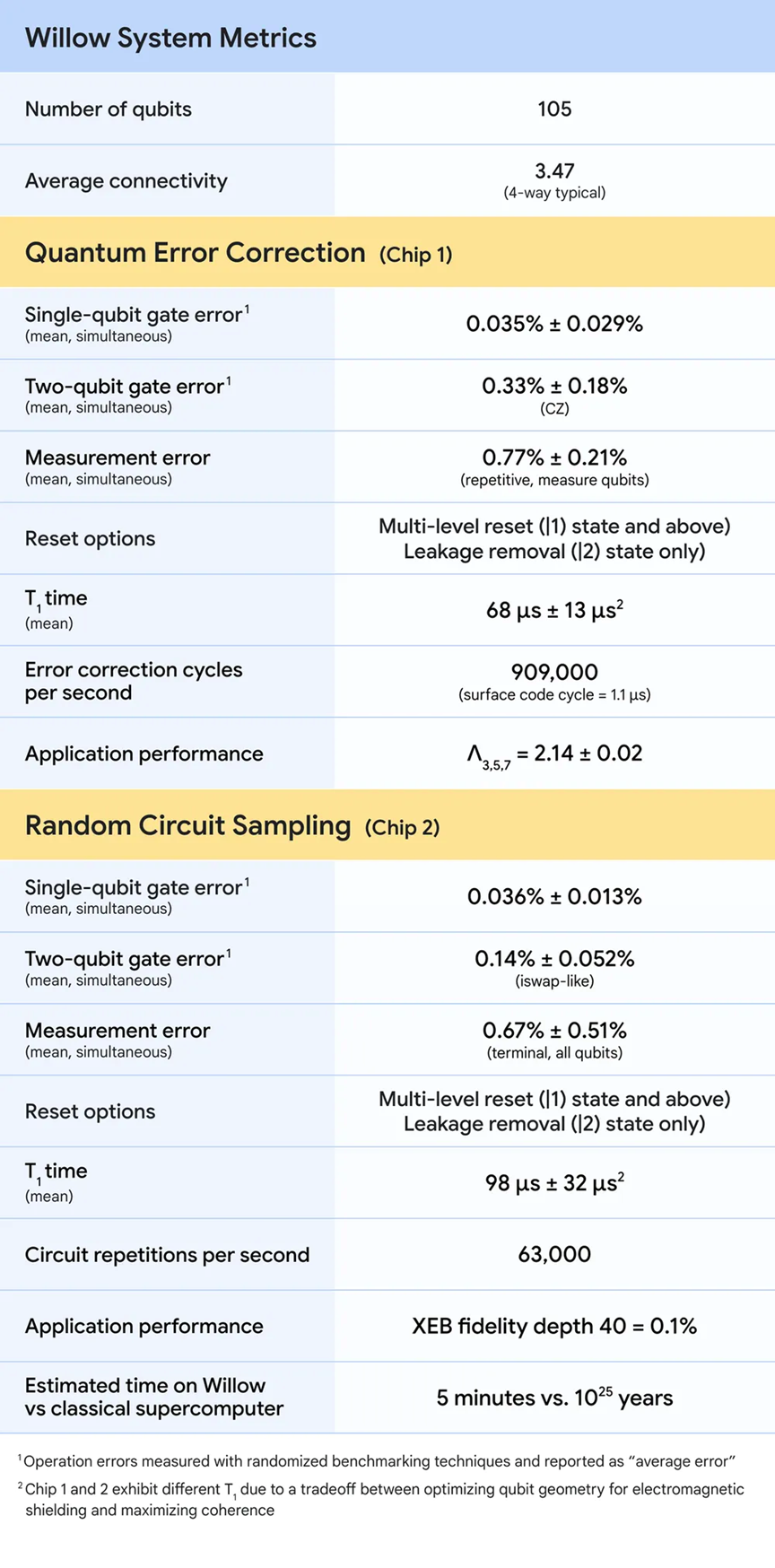
Google prioritizes quality over quantity—because simply producing more qubits won't help if the quality isn't high enough. Willow, with its 105 qubits, achieves best-in-class performance on both of the aforementioned system benchmarks: quantum error correction and random circuit sampling. These algorithmic benchmarks are the best way to measure a chip's overall performance. Other, more specific performance metrics are also crucial; for example, Google's T1 time (a measure of how long a qubit can remain in an excited state, a key quantum computing resource) is now approaching 100 µs (microseconds). This represents an impressive performance improvement of approximately 5x over the previous generation of chips. To evaluate quantum hardware and compare across platforms, please see the following key specification table:
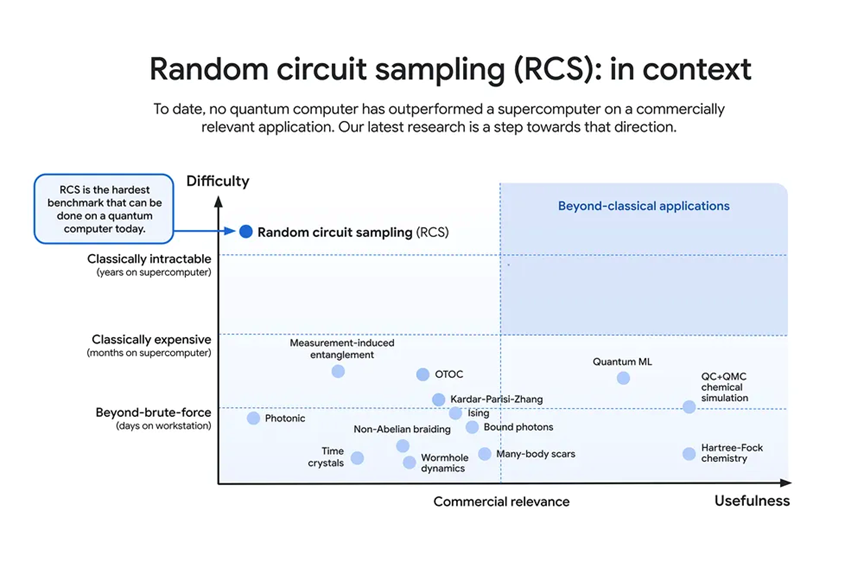
At the time, Google stated that the next challenge in the field was to demonstrate the first "practical, superclassical" computation on a current quantum chip (the goal mentioned at the beginning of the article) and make it relevant to real-world applications. Google is optimistic that the Willow generation of chips will help us achieve this goal. To date, Google has conducted two types of experiments. On the one hand, Google runs the RCS benchmark, which measures performance compared to classical computers but has no known practical applications. On the other hand, Google performs scientifically meaningful simulations of quantum systems, which have led to new scientific discoveries but remain within the reach of classical computers. Google's goal is to achieve both goals simultaneously—to enter the realm of algorithms that are beyond the reach of classical computers and to enable them to solve real-world, business-relevant problems.
Source: Content compiled from Google, etc.