


AMD hopes to patent a new DDR5 memory standard that will double the bandwidth, but we don't expect it to appear on PCs anytime soon.
12.8 Gbps of raw bandwidth, but will the industry adopt it?
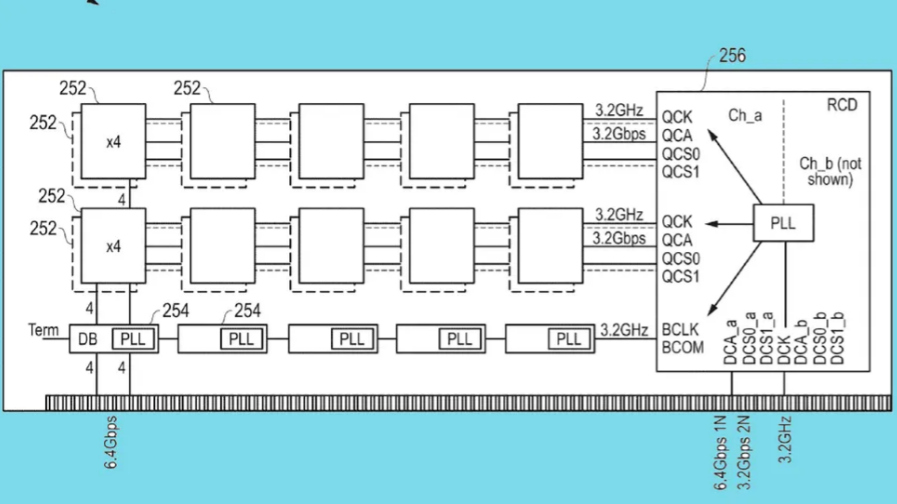
An AMD patent application for a new version of DDR5 PC memory has been revealed. The so-called High-Bandwidth Dual In-line Memory Module (HB-DIMM) aims to boost memory bandwidth through pseudo-channels, buffer chips, and intelligent signal routing. It looks impressive, but we'll have to wait and see if it shows up on PCs soon.
The AMD patent application, uncovered by Tech4Gamers, explains the increasing memory bandwidth demands of modern computing platforms.
The filing states: "Because the memory bandwidth requirements of applications such as high-performance graphics processors and servers (which have multiple cores and correspondingly increasing per-core bandwidth requirements) exceed the DDR DRAM chip bandwidth improvement roadmap, improvements to DIMM architecture are needed to meet these requirements with current DDR chip technologies, such as DDR5."
The answer? "High-Bandwidth DIMMs (HB-DIMMs). This approach is designed to leverage the advantages of the High-Bandwidth Memory (HBM) format within the DIMM form factor."
Each HB-DIMM primarily consists of a memory chip and a buffer chip. The application states: "The data buffer chip is connected to the corresponding memory chipset and transmits data from the memory chips via the host bus at twice the rate of the memory chips."
The design also relies on so-called "pseudo" memory channels and advanced signaling. "The RCD circuit includes a host bus interface and a memory interface connected to the plurality of memory chips. The RCD circuit executes commands received via the host bus by routing command/address (C/A) signals to the memory chips, thereby providing at least two independently addressable pseudo channels, the RCD circuit addressing each pseudo channel based on chip identifier (CID) bits derived from the C/A signals."
If we understand correctly, this is a bit like having a dual-channel memory interface on a single memory DIMM. Regardless, the end result effectively doubles the native speed of DDR5 from 6.4 Gbps to 12.8 Gbps. The clever part, of course, is that this is all achieved using existing DDR5 memory chips. No new generation of chips is required.
On the other hand, the CPU, chipset, and motherboard required to support this new HB-DIMM memory module may not be new, but that doesn't seem to be a given. The history of proprietary memory standards in the PC world isn't very rich.
As the patent application itself states, "Most DRAM chips currently sold are compatible with various Double Data Rate (DDR) DRAM standards promulgated by the Joint Electron Device Engineering Council (JEDEC)." For PCs, you could almost replace "most" with "all."
So, the question is how likely this new standard is to be adopted. One obvious path would be for JEDEC to adopt it and make it essentially free for use. It's hard to imagine Intel paying royalties to AMD. Despite its recent struggles, Intel remains the largest player in the PC platform space. So, you might think Intel would have to get on board for HB-DIMMs to truly take off.
Source: Content from pcgamer