

According to data from Jon Peddie Research, desktop discrete graphics card shipments reached their second-highest level in nearly a decade last year, and are projected to increase by nearly 10 million units by 2025, reaching approximately 44.28 million units. However, the vast majority of graphics cards sold last year used Nvidia's GeForce GPUs, while sales of AMD Radeon graphics cards plummeted to a record low.
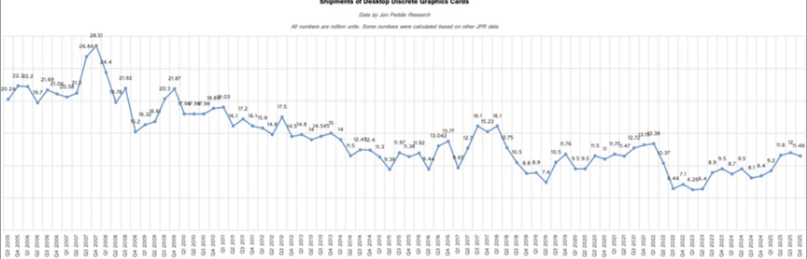
In 2025, the graphics card industry shipped 44.28 million units, up from 34.7 million in 2024, primarily driven by NVIDIA's release of the GeForce RTX 50 series graphics processors based on the Blackwell architecture. Desktop discrete graphics card sales peaked in the third quarter with 12 million units shipped, followed by a slight quarter-over-quarter decline in the fourth quarter, with discrete graphics card manufacturers (AIBs) shipping 11.48 million units, still higher than the 8.4 million units shipped in the same period last year. Typically, desktop graphics card sales peak in the fourth quarter as gamers prepare for new game releases. However, this was not the case in 2025 for various reasons.
AIB Market
Dr. Jon Peddie, president of Jon Peddie Research, explained: "The AIB market is primarily supported by gamers, but it is currently being squeezed from the low-end market due to the emergence of powerful new laptops and CPUs with integrated graphics; at the same time, the high-end market is also being squeezed due to competition (supply and demand), rising memory prices, and the fluctuating tariff policies of the Trump administration."
In 2025, graphics card shipments reached 44.28 million units, up from 34.7 million units in 2024, primarily driven by NVIDIA's release of the GeForce RTX 50 series graphics processors based on the Blackwell architecture. Desktop discrete graphics card sales peaked in the third quarter with 12 million units shipped, followed by a slight quarter-over-quarter decline in the fourth quarter, with AIB (Add-in Board) shipments reaching 11.48 million units, still higher than the 8.4 million units shipped in the same period last year. Typically, desktop graphics card sales peak in the fourth quarter as gamers prepare for new game releases. However, this is not the case in 2025 for several reasons.
Dr. Jon Peddie, President of Jon Peddie Research, explained, "The AIB market is primarily supported by gamers, but it is currently being squeezed from the low-end market due to powerful new laptops and CPU integrated graphics; at the same time, the high-end market is also being squeezed due to competition (supply and demand), rising memory prices, and the fluctuating tariff policies of the Trump administration."
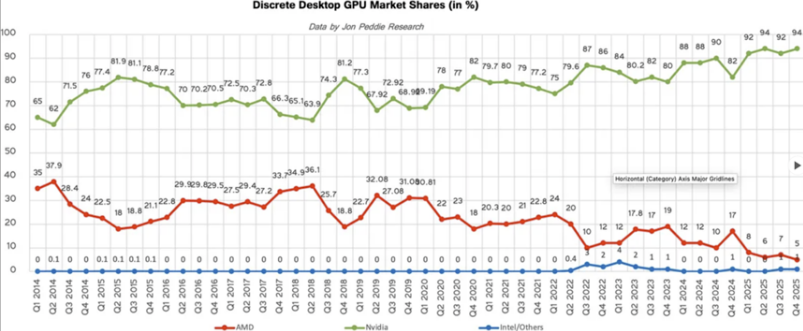
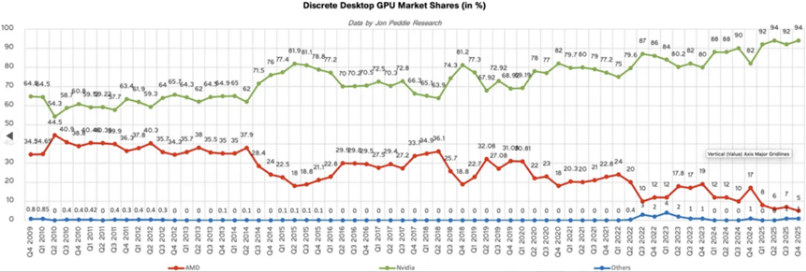
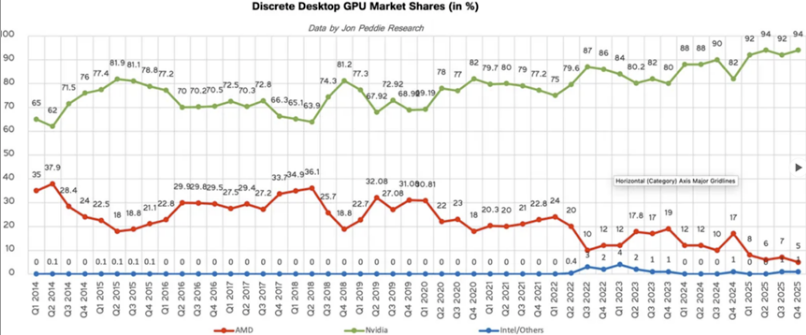
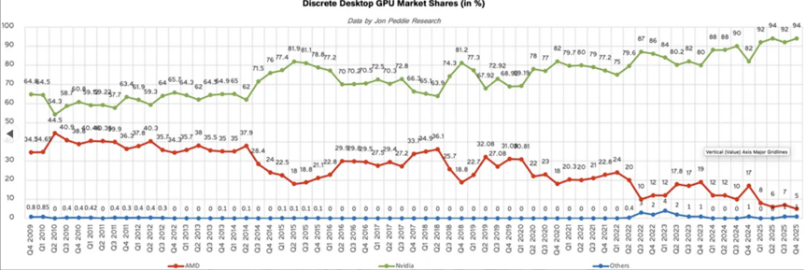
In terms of market share, Nvidia dominated throughout 2025. In the first quarter, Nvidia held a 92% market share, which rose to 94% in the fourth quarter (a 1.6% increase in the fourth quarter alone). In contrast, AMD's graphics card shipments were only 8% in the first quarter of 2025, as the company prepared to launch its Radeon RX 9000 series GPUs. By the fourth quarter, AMD's market share was only 5%, perhaps due to a lack of acceptance among its target user groups, possibly due to limited supply at the suggested retail price in the early stages of the product lifecycle.
AMD (or ATI Technologies) held only a 5% share of the desktop discrete graphics card market, its lowest share ever. While the company has a significant share in the integrated graphics market, as almost all desktop Ryzen processors integrate an iGPU, this is a stark contrast to the desktop discrete graphics card market, where user loyalty and profitability are far lower.
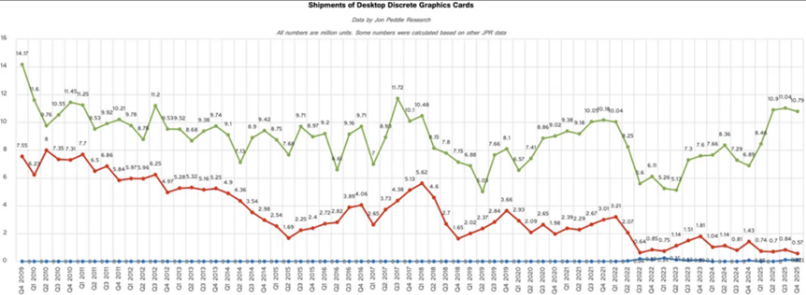
As Nvidia's market share continues to grow in 2025, while AMD's continues to decline, its graphics card shipments also fell from 740,000 units in the first quarter to 570,000 units in the fourth quarter. Again, this quarterly graphics card sales of 570,000 units is the lowest record for both AMD and its predecessor, ATI.
As for Intel, although the company released some new Arc graphics cards based on the Battlemage architecture, they were primarily targeted at specific market segments, which is why Intel did not gain any market share in 2025.
Source: Compiled from tomshardware